How to Identify Backyard Birds: A Beginner’s Guide
This post contains affiliate links. If you buy through them, Birdstyl may earn a small commission at no extra cost to you. Read our Affiliate Disclosure.
Every backyard birder eventually faces the same moment: a bird lands at the feeder, and you have no idea what it is. It is not quite a robin. It is definitely not a cardinal. It is something brown and streaky and gone before you can get a closer look. Learning to identify backyard birds is one of the most rewarding skills a birder can build, and it is far more approachable than most beginners expect. This guide walks you through the system that experienced birders actually use, with a focus on the most common species you are likely to encounter across the United States.
The identification tips and species information in this guide draw on research from the Cornell Lab of Ornithology, Project FeederWatch, and the National Audubon Society. Sources are listed at the bottom of this page.
Start With the Four Keys to Bird Identification
Experienced birders use a framework called the four keys to bird identification. These four categories cover the information you need to name almost any bird you see, and training yourself to notice them systematically will speed up your learning faster than any app or field guide.
The four keys are size and shape, color pattern, behavior, and habitat. Cornell recommends focusing on size and shape first, because those features stay consistent regardless of lighting, season, or the angle you are observing from. Color can fool you in low light or when a bird is molting, but the basic silhouette of a House Finch versus a Mourning Dove will never mislead you.
When a bird lands in front of you, run through the four keys in order. How big is it compared to a bird you already know? Is it the size of a sparrow, a robin, or a crow? What is the shape of its bill? Short and thick bills suggest seed eaters. Long, thin bills suggest insect eaters or nectar feeders. A hooked bill points to a bird of prey. Next, notice the most striking color or pattern — a crest, wing bars, a distinctive breast pattern, or a colored cap. Then watch what the bird does and where it is feeding. These four observations together will narrow a mystery bird to a small group of candidates before you ever open a field guide.
The 10 Most Common Backyard Birds in the US
Project FeederWatch, which tracks bird visits at thousands of backyard feeders across North America every winter, consistently finds the same group of species at the top of its lists. Getting familiar with these ten birds will give you a solid foundation that covers the vast majority of what you will see at a typical US backyard feeder.
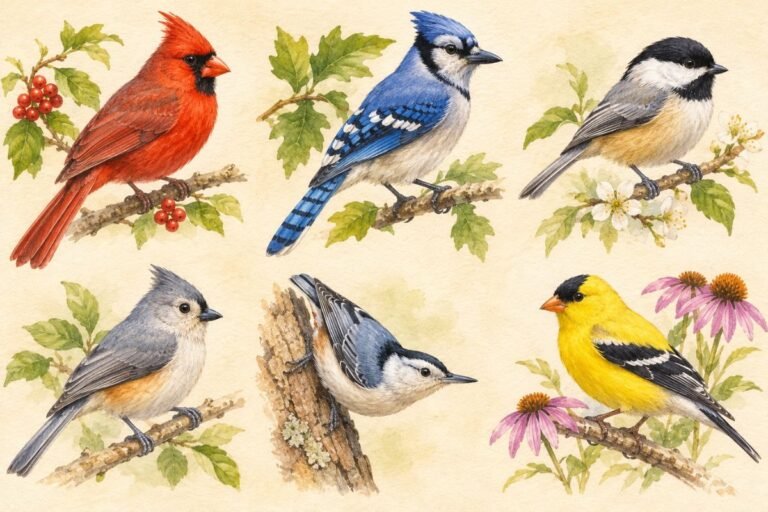
Northern Cardinal — The male is unmistakable: entirely red with a black mask and a prominent pointed crest. Females are tan-brown with reddish tinges on the wings and crest. Cardinals appear at feeders year-round across the eastern two-thirds of the US. They strongly prefer sunflower seeds and tend to visit at dawn and dusk more than midday. Northern Cardinals rank among the top-recorded species at Project FeederWatch sites across most eastern and midwestern states.
Dark-eyed Junco — Juncos are small sparrows with dark gray or brownish-gray plumage and a noticeably white belly. The most reliable field mark is the flash of white outer tail feathers they show when they fly. Juncos are ground feeders and are far more common at feeders in fall and winter, when they migrate south from northern forests. Cornell describes them as one of the most abundant birds in North America.
American Goldfinch — Males in breeding plumage are brilliant yellow with black wings and a black cap. In winter, both males and females are a dull yellowish-olive. Goldfinches are small, with a short notched tail and a stubby bill. They strongly prefer Nyjer seed and are acrobatic feeders that cling to tube feeders with ease. The wing pattern — two white wing bars on black wings — is visible year-round and helps confirm an ID in winter when the yellow is gone.
House Finch — Male House Finches have red on the head, throat, and breast, with heavy brown streaking on the flanks. Females are entirely brown and streaky without any red. House Finches are common across the entire US and are one of the most frequent feeder visitors in suburban yards. Audubon notes that House Finches were originally native to the western US and were introduced to the east in the 1940s, where they have spread widely since.
Mourning Dove — Large and slender, Mourning Doves are pale grayish-brown with black spots on the wings and a long pointed tail. They are ground feeders and spend most of their time under feeders pecking up spilled seed. Their cooing call is one of the most recognizable sounds in suburban backyards. Cornell notes that Mourning Doves are among the most numerous land birds in North America.
Downy Woodpecker — The smallest woodpecker in North America, the Downy is about the size of a sparrow. It has a bold black-and-white pattern with white spots on the wings and a white back stripe. Males have a small red patch on the back of the head; females do not. Downy Woodpeckers are common at suet feeders and will also visit tube feeders for sunflower seeds. They are present year-round across most of the US.
Black-capped Chickadee — Chickadees are small, energetic birds with a black cap, black bib, white cheeks, and soft gray back and wings. They are bold and curious, often the first birds to discover a new feeder. Their call — a clear chick-a-dee-dee-dee — is one of the most distinctive sounds in eastern and northern backyards. Carolina Chickadees replace them in the South and look nearly identical, but have a slightly more muted plumage.
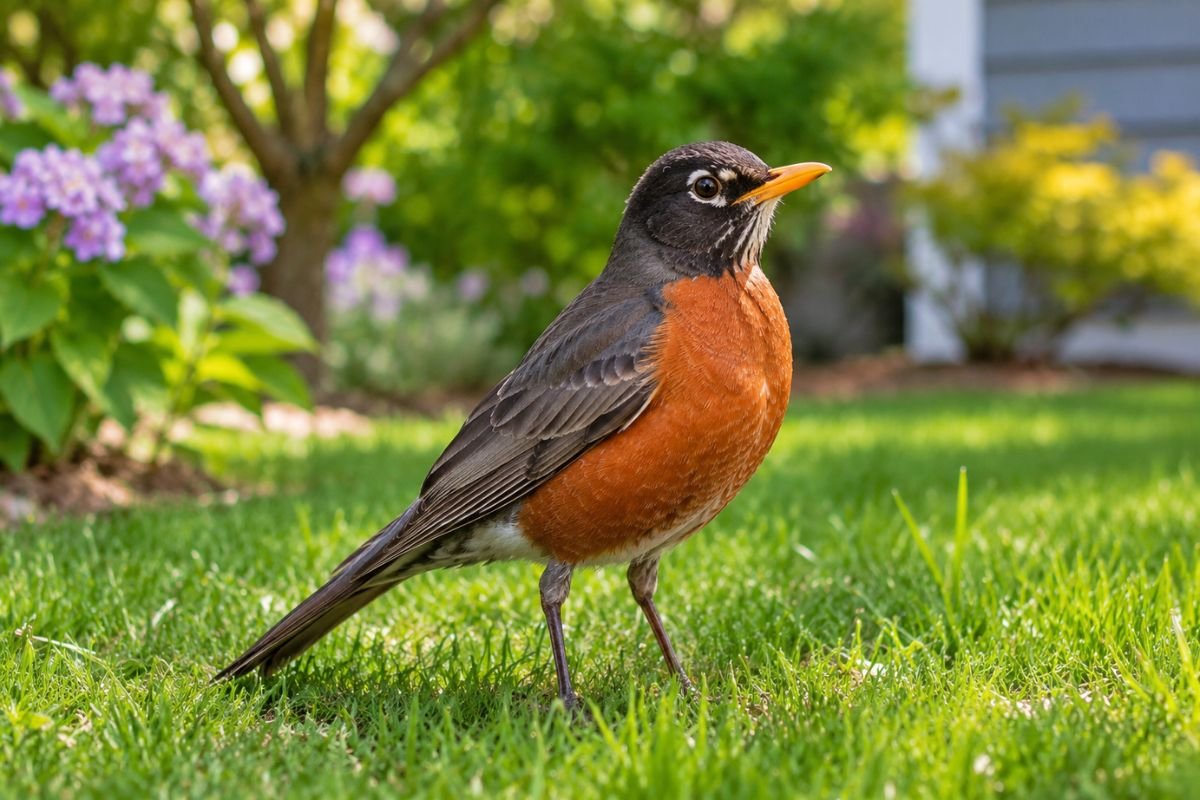
American Robin — Robins are large thrushes with a brick-red breast and a dark gray-to-black back. They are common across the entire US and are one of the first birds people learn to identify. Robins do not typically visit seed feeders — they prefer earthworms, insects, and berries. If you want to attract robins, offer a birdbath or plant fruit-bearing trees like crabapple or serviceberry. Cornell notes that robins can be seen year-round across most of the lower 48 states, though northern populations move south in hard winters.
Tufted Titmouse — A small gray bird with a prominent pointed crest, rusty sides, and large black eyes. Titmice are energetic and vocal, often heard before they are seen. They visit feeders year-round in the eastern US and are especially attracted to sunflower seeds and peanuts. Project FeederWatch data consistently shows them in the top ten at eastern feeder sites. The crest is the most distinctive feature — no other small gray bird at an eastern feeder has one.
White-breasted Nuthatch — Nuthatches are compact birds with a gray back, white underparts, and a black cap. The defining behavior — walking headfirst down tree trunks — sets them apart from every other bird at the feeder. They visit suet cages and tube feeders and are common year-round across most of the US. Cornell describes their nasal yank-yank call as one of the most reliable sounds for locating them in wooded backyards.
How to Tell Similar Species Apart
Several common backyard birds look confusingly similar to one another, especially for beginners. Knowing the key differences between the most-confused pairs will save a lot of frustration.
House Finch vs. Purple Finch — Both have red males and streaky brown females, but they can be separated by looking at the breast. House Finch males have distinct brown streaking running down the sides and belly. Purple Finch males are more uniformly raspberry-red with less streaking, and the face pattern is bolder. Cornell describes the Purple Finch as looking like it has been dipped in raspberry juice. Purple Finches are also less common at feeders than House Finches in most areas.
Downy Woodpecker vs. Hairy Woodpecker — These two look nearly identical: same black-and-white pattern, same red patch on males. The key difference is bill length. The Downy has a short, stubby bill that is noticeably shorter than the width of its head. The Hairy Woodpecker has a long, chisel-like bill about the same length as its head. The Hairy is also larger overall, roughly the size of a robin, while the Downy is sparrow-sized. When both appear at the same feeder, the size difference is obvious.
Cooper’s Hawk vs. Sharp-shinned Hawk — Both are small accipiters that visit backyards to hunt songbirds at feeders. The Sharp-shinned is smaller and has a squared tail. The Cooper’s is larger and has a rounded tail. When perched, Cooper’s Hawks show a more rounded head with a flat-topped look; Sharp-shinned Hawks have a rounded head with a more peaked appearance. These two are notoriously difficult even for experienced birders, and size is the most reliable feature when you can judge it.
American Crow vs. Common Raven — Ravens are significantly larger than crows — roughly the size of a Red-tailed Hawk — and have a wedge-shaped tail compared to the crow’s fan-shaped tail. Ravens also have a heavier, more curved bill and tend to soar more. Crows typically flap more steadily. In most suburban backyards you are far more likely to see crows than ravens, which prefer wilder habitats. The tail shape in flight is the most reliable feature when size is hard to judge.
Use Song and Call to Identify Birds You Cannot See
Many experienced birders identify more birds by ear than by sight. Learning the songs and calls of common backyard species dramatically increases what you can detect, especially in summer when dense foliage hides birds that are singing loudly. Cornell’s Merlin Bird ID app includes a sound ID feature that listens and identifies birds in real time — it is one of the most useful free tools available for beginners and works across the entire US.
A few calls are worth learning first because they are distinctive and common. The chickadee’s fee-bee whistle is two clear notes — the second lower than the first. The cardinal has a loud, clear cheer-cheer-cheer and a sharp metallic chip note. The American Robin sings a cheerily-cheer-up-cheerio song in a series of phrases. Mourning Doves produce a soft, repetitive cooo-ooo-oo that many people mistake for an owl. The White-breasted Nuthatch’s nasal yank is easy to pick out once you know it. Learning five or six calls to start will help you place birds without ever seeing them.
Use a Smart Camera Feeder to Speed Up Learning
One of the fastest ways to learn backyard bird identification is to watch the same birds repeatedly in close detail. A camera feeder lets you do exactly that — you can pause footage, zoom in, and study a bird’s field marks at your own pace without the bird flying off. For anyone who wants to learn identification without spending hours outside with binoculars, a camera feeder changes the whole dynamic.
The Birdfy smart camera feeder uses AI to identify birds automatically and sends a notification to your phone with the species name each time a new visitor lands. For someone learning to identify birds, this instant confirmation is genuinely useful — you see the bird, you get the name, and you can compare the two until the connection becomes natural. The camera records every visit, so you can review footage from during the day without missing anything that happened while you were away.
Keep a Simple Yard List
One of the best habits a beginning birder can build is keeping a yard list — a running record of every species you have confirmed in your backyard. It does not need to be elaborate. A note in your phone or a small notebook by the window works fine. The act of writing down each confirmed species forces you to study the bird carefully enough to be sure, which trains your eye faster than casual observation.
Project FeederWatch invites backyard birders to submit their counts to contribute to real scientific research. Participants count birds at their feeders on two consecutive days each week from November through April and submit the numbers online. The data goes directly into Cornell’s population tracking system and helps researchers identify changes in bird distribution and health across North America. It is free to join for the first year and costs a small annual fee after that.
Even if you do not join FeederWatch, keeping a yard list gives you something to build toward. Many backyard birders are surprised by how many species visit their yard over the course of a year. A typical suburban yard in the eastern US can rack up 30 to 50 species across all four seasons if you watch consistently. The list gives you a reason to keep paying attention — and every new species on it means you have learned one more bird for life.
Best Tools for Backyard Bird Identification
A few resources stand out as genuinely useful for beginners learning to identify backyard birds.
Cornell’s free Merlin Bird ID app is the most recommended starting point. It offers three ways to identify a bird: answer five questions about size, color, and behavior; upload a photo; or use the live sound ID feature. The app covers every species in North America and includes range maps, photos, and recordings of calls and songs for each one. It is the tool most frequently cited by birding organizations as the best free resource for beginners.
Cornell’s All About Birds website is the most comprehensive free reference available. Each species page includes multiple photos showing males, females, and juveniles in different seasons, range maps, recordings of calls and songs, and detailed notes on habitat, behavior, and feeding preferences. When you are trying to confirm an identification or learn more about a species you have spotted, All About Birds is the best place to go.
For a physical field guide, the Sibley Guide to Birds and the Peterson Field Guide to Birds of North America are both excellent references. The Sibley guide is widely regarded as the most thorough option for North America. The Peterson system uses illustrated plates that show multiple species side by side for direct comparison, which many beginners find easier to use than photo-based guides.
If you want to identify birds without leaving your chair, the Birdfy camera feeder does the identification for you and builds a log of every species that visits. It is especially useful for people who cannot spend long periods at the window but still want to know what is coming to the yard. See our full guide to smart feeders in the Smart Feeders section for more on what camera feeders can do.
Quick Reference: Field Marks for 10 Common Species
- Northern Cardinal: Red male with black mask and crest; tan female with red crest and bill
- Dark-eyed Junco: Dark gray with white belly; white outer tail feathers flash in flight
- American Goldfinch: Bright yellow male with black wings in summer; olive-yellow in winter; two white wing bars year-round
- House Finch: Red head and breast with streaked sides on male; streaky brown female; curved upper bill
- Mourning Dove: Pale grayish-brown with long pointed tail; black spots on wings; ground feeder
- Downy Woodpecker: Black and white with stubby bill shorter than head width; red patch on male only
- Black-capped Chickadee: Black cap and bib; white cheeks; small and round; energetic
- American Robin: Red-orange breast; dark back; large and upright posture; eats worms not seeds
- Tufted Titmouse: Gray with pointed crest; rusty sides; large black eyes
- White-breasted Nuthatch: Gray back, black cap, white underparts; walks headfirst down tree trunks
Final Thoughts
Bird identification improves quickly once you start applying a system. Begin with size and shape, add color pattern, watch behavior, and note the habitat. Learn the ten most common species at US backyard feeders and you will recognize the majority of your visitors from day one. Use Merlin for real-time help, keep a yard list to track your progress, and add a camera feeder if you want to identify birds without the bird ever knowing you are watching. The more you look, the more you see — and the more you see, the more you will want to keep looking.
Sources
Cornell Lab of Ornithology — All About Birds species accounts and identification guides (allaboutbirds.org)
Project FeederWatch — Annual data on most common feeder birds across North America (feederwatch.org)
National Audubon Society — Species accounts and backyard birding resources (audubon.org)