How to Identify 12 Common Backyard Birds at Your Feeder
This post contains affiliate links. If you buy through them, Birdstyl may earn a small commission at no extra cost to you. Read our Affiliate Disclosure.
You fill the feeder, the birds arrive, and then the big question starts: who is that? Learning to identify backyard birds is one of the most rewarding parts of feeding them. Once you can put a name on each visitor, you start noticing who comes every day, who shows up only in winter, and who chases everyone else away.
This guide shows you how to identify 12 common backyard birds that visit feeders across much of the United States, especially in the eastern half of the country. For each bird you will find its size, the field marks to look for, and a behavior clue that makes it easier to recognize. Sizes come from the Cornell Lab of Ornithology’s All About Birds guide, and the full list of sources is at the end of the article.
Four Simple Clues for Identifying Any Bird
Before looking at specific birds, it helps to know what to look at. The Cornell Lab teaches beginners to focus on four clues, in this order:
- Size and shape. Is the bird smaller than a sparrow, about robin sized, or as big as a crow? Look at the bill, the tail, and whether it has a crest.
- Color pattern. Do not try to memorize every feather. Notice the main areas: a dark cap, a bright breast, white wing bars, or white outer tail feathers.
- Behavior. How does it move and feed? Some birds hop on the ground, some cling to tree trunks, and some climb down trees headfirst.
- Habitat. Where is it? On the feeder, under the feeder, on a tree trunk, or in a dense shrub?
Using these four clues together is much more reliable than color alone. Light, shade, and wet feathers can make colors look very different from one moment to the next, while shape and behavior stay the same.
Northern Cardinal
Size: 8.3 to 9.1 inches long.
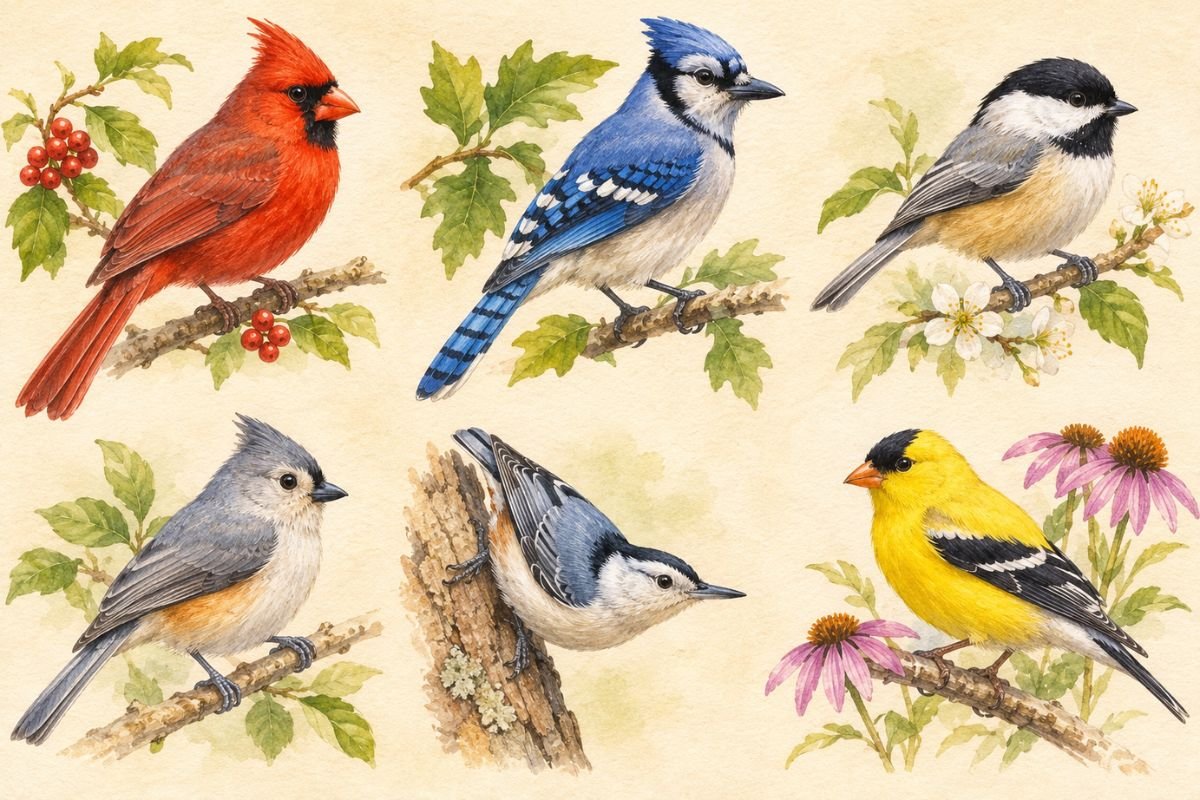
The male is bright red with a pointed crest, a black face, and a thick orange-red bill. The female is warm tan with red tones on her crest, wings, and tail, and she has the same heavy bill. Cornell notes that cardinals often sit hunched over with the tail pointed straight down. They usually feed on platform feeders or on the ground below them. Our guide on how to attract cardinals explains what they like to eat.
Blue Jay
Size: 9.8 to 11.8 inches long. Cornell describes it as smaller than a crow and larger than a robin.
Look for a blue crest, bright blue wings and tail with black bars and white patches, a whitish face and belly, and a black necklace around the throat. Blue Jays are loud and confident. They often arrive in small groups, call noisily, and carry off peanuts or large seeds to hide for later.
Black-capped Chickadee and Carolina Chickadee
Size: small, roughly 4.5 to 6 inches long.
Chickadees have a black cap, a black bib under the bill, bright white cheeks, a gray back, and buffy sides. They are tiny, round, and full of energy. A chickadee usually grabs one seed, flies to a nearby branch, and hammers it open before coming back for the next one. In the Southeast you will see the very similar Carolina Chickadee, and where the two ranges meet, telling them apart can be tricky even for experts. Location is often the best clue.
Tufted Titmouse
Size: 5.5 to 6.3 inches long.
This small gray bird has a pointed gray crest, a black patch just above the bill, large dark eyes, a pale belly, and a rusty or peach wash on its sides. Like chickadees, titmice often take one seed at a time and fly off to open it. They are common in eastern woodlands and backyards with mature trees.
White-breasted Nuthatch
Size: 5.1 to 5.5 inches long. Cornell calls it the largest nuthatch, but still a small bird with a large head and almost no neck.
Look for a blue-gray back, a white face and breast, and a black or dark gray cap. The best clue is behavior: nuthatches creep along tree trunks and often climb down headfirst, something few other feeder birds do. They love sunflower seed, suet, and peanuts.
Downy Woodpecker and Hairy Woodpecker
Size: Downy 5.5 to 6.7 inches. Hairy 7.1 to 10.2 inches.
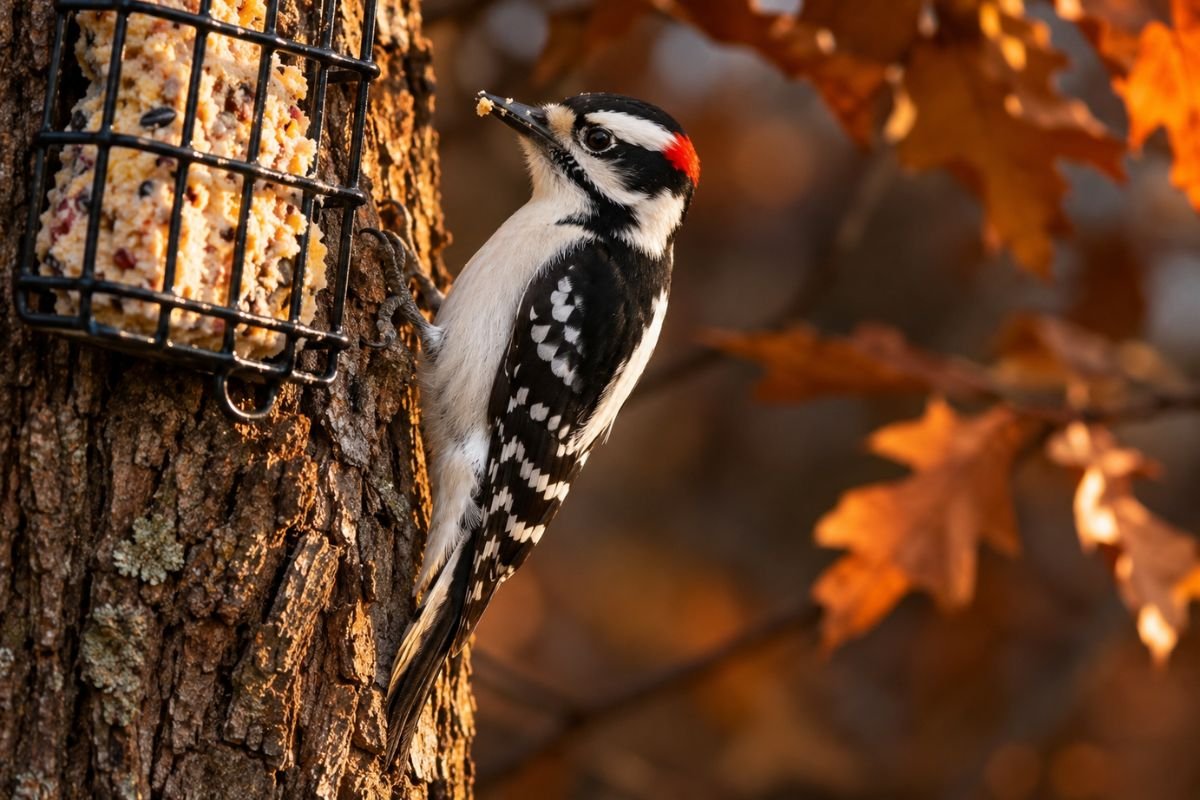
These two look almost identical: black and white with a white stripe down the back, white spots on black wings, and a small red patch on the back of the head in males. The difference is size and bill. Cornell describes the Downy as about two-thirds the size of a Hairy, with a bill that looks small for its head. The Hairy’s bill is long and chisel-like, nearly as long as its head. If the bill looks short and stubby, it is probably a Downy. Both are regular visitors to suet feeders.
Red-bellied Woodpecker
Size: about 9.4 inches long.
Despite its name, the red belly is hard to see. Instead, look for a back with tight black and white bars, a pale tan face and chest, and red on the head. Males have red from the bill over the top of the head to the neck, while females have red only on the back of the neck. Red-bellied Woodpeckers visit suet, peanut, and sunflower feeders and often call with a rolling, churring sound.
American Goldfinch
Size: 4.3 to 5.1 inches long.
In summer, males are bright lemon yellow with a black cap and black wings. In winter, both males and females turn a dull olive or brownish color, but they keep black wings with pale wing bars and a short, cone-shaped bill. That winter look surprises many people. Goldfinches flock to nyjer and sunflower feeders, often in noisy groups.
House Finch
Size: 5.1 to 5.5 inches long.
Males have a red head, breast, and rump over a brown, streaky body. Females are plain brown with blurry streaks and no strong face pattern. Cornell notes that males can look very different from one another, from deep red to orange or yellow, because their color depends on diet. House Finches often arrive in flocks and stay at the feeder for a long time.
Dark-eyed Junco
Size: about the size of a sparrow, roughly 5.5 to 6.3 inches long.
In the East, juncos are slate gray above with a clean white belly and a small pale pink bill. When they fly, they flash bright white outer tail feathers. Juncos in the West can show brown backs or a dark hood. Many people call them snowbirds because they arrive at feeders in large numbers when winter begins. They feed mostly on the ground, so scatter some millet below the feeder for them.
Mourning Dove
Size: 9.1 to 13.4 inches long.
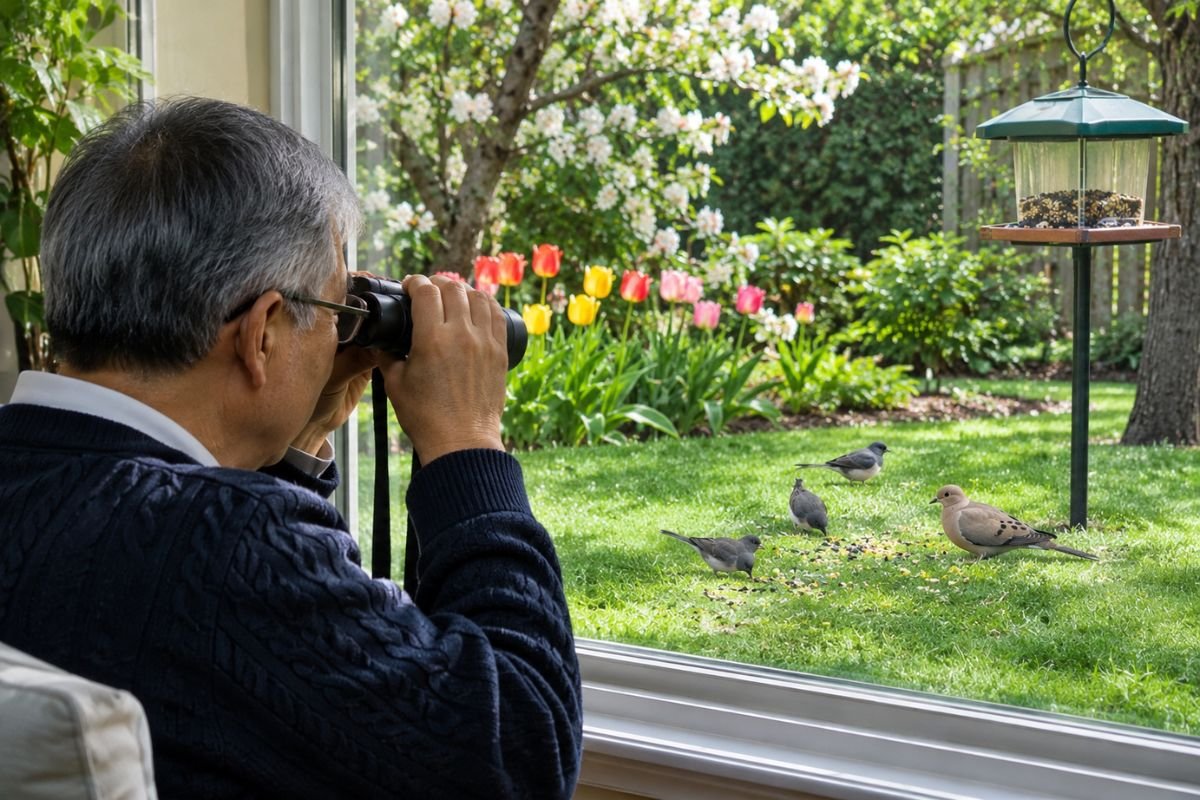
This slim, soft tan bird has a small round head, black spots on the wings, and a long pointed tail. Cornell notes that its long, pointed tail is unique among North American doves. Mourning Doves feed calmly on the ground or on platform feeders, and their wings make a whistling sound when they take off.
American Robin
Size: roughly 8 to 11 inches long.
Robins have a gray-brown back, a warm orange breast, a dark head, and a yellow bill. You will usually see them on the lawn rather than at seed feeders, running a few steps and stopping to look for worms. In winter, many robins gather in flocks and eat fruit, so a bird bath or berry bushes may bring them closer than a seed feeder will.
Tools That Make Bird Identification Easier
You do not need expensive equipment to start. A simple notebook to write down what you see, a pair of basic binoculars, and a field guide or a free bird ID app on your phone can take you a long way. The Cornell Lab’s free Merlin Bird ID app, for example, asks a few simple questions or uses a photo to suggest a species.
A camera feeder can help too, because it records close-up clips you can watch again and compare. Many models, like the Birdfy smart bird feeders, also suggest the species automatically. Treat those labels as a helpful first guess, not a final answer, and check the field marks in this guide. Our article Are Smart Bird Feeders Worth It? explains the pros and cons in detail.
Tips to Get Better at Identifying Birds
- Start with your feeder regulars. Learn the five or six birds you see most often. New birds will stand out once you know the common ones well.
- Watch before you reach for the book. Spend a few seconds noting size, shape, and behavior before the bird flies away.
- Compare with a bird you know. Ask yourself if it is bigger or smaller than a sparrow, a robin, or a crow.
- Remember the season. Some birds change color through the year, and some visit only in winter.
- Offer different foods. A mix of sunflower seed, suet, nyjer, and millet brings in more kinds of birds. Our guide on what to feed birds in winter shows which food attracts which bird.
Quick Identification Cheat Sheet
- Red bird with a crest: male Northern Cardinal.
- Blue bird with a crest and black necklace: Blue Jay.
- Tiny bird with a black cap and bib: chickadee.
- Small gray bird with a crest and rusty sides: Tufted Titmouse.
- Bird climbing down a tree headfirst: White-breasted Nuthatch.
- Black and white woodpecker with a short bill: Downy Woodpecker.
- Barred back and red on the head: Red-bellied Woodpecker.
- Olive bird with black wings in winter: American Goldfinch.
- Streaky brown bird with a red head: male House Finch.
- Gray bird with a white belly and white tail edges: Dark-eyed Junco.
- Tan bird with a long pointed tail: Mourning Dove.
- Orange breast on the lawn: American Robin.
Keep this list near your window and use it the next time a new bird lands. If you want to review every visitor later, a camera feeder lets you replay the clip and check the field marks at your own pace.
Sources
- All About Birds, Cornell Lab of Ornithology: species identification pages for Northern Cardinal, Blue Jay, Tufted Titmouse, White-breasted Nuthatch, Downy Woodpecker, Hairy Woodpecker, Red-bellied Woodpecker, American Goldfinch, House Finch, and Mourning Dove (allaboutbirds.org)
- All About Birds, Cornell Lab of Ornithology: Northern Cardinal Life History (allaboutbirds.org)
- Cornell Lab of Ornithology: Merlin Bird ID app (merlin.allaboutbirds.org)
- Project FeederWatch: Food Types (feederwatch.org)