How to Attract Blue Jays to Your Backyard
This post contains affiliate links. If you buy through them, Birdstyl may earn a small commission at no extra cost to you. Read our Affiliate Disclosure.
Blue Jays are hard to miss. That bold blue, black, and white pattern and the loud, familiar call make them one of the most recognizable birds in North America. They are also one of the smartest birds you can invite into your yard, known for their memory, complex family bonds, and habit of stashing hundreds of acorns for winter. If you want more Blue Jays visiting your backyard, the right food and setup will bring them in quickly.
This guide covers everything you need to know about how to attract Blue Jays, from the foods they prefer and the feeders that work best to the plants that make them feel at home. All information comes from the Cornell Lab of Ornithology, the National Audubon Society, and Project FeederWatch, with the full source list at the bottom of the page.
Get to Know the Blue Jay
The Blue Jay (Cyanocitta cristata) is a large songbird in the crow family. According to the Cornell Lab’s All About Birds, it is found across the eastern and central United States and into Canada, in forests, parks, and suburban backyards. Despite its striking colors, it blends into dappled light under oak trees surprisingly well.
Blue Jays are highly intelligent and social. Cornell notes that they form long-term pair bonds and often travel in family groups. They have a wide range of calls, including a perfect imitation of Red-shouldered and Red-tailed Hawks, which they sometimes use to alert other jays to danger, and sometimes just to claim space at a feeder.
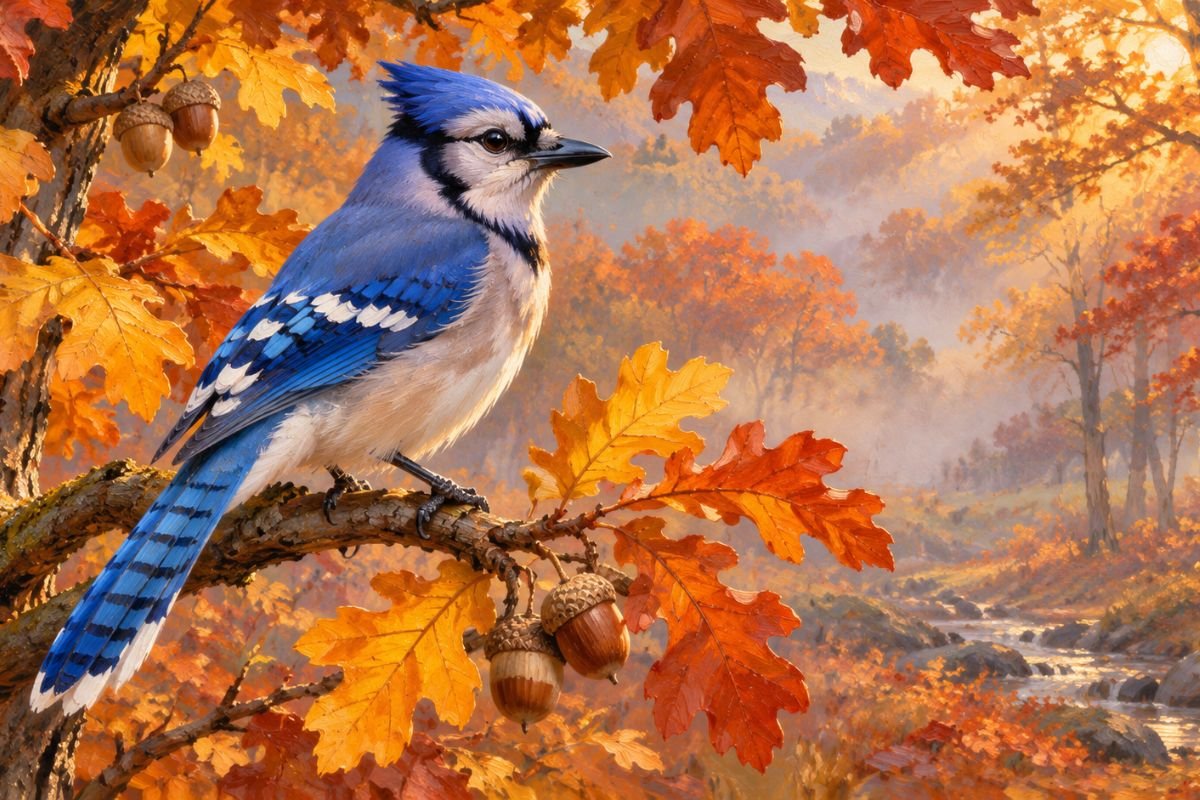
One behavior that makes Blue Jays especially valuable to the yard and to forests is their habit of caching food. Cornell reports that a single Blue Jay can carry up to five acorns at once in its throat pouch and bill, and scientists believe Blue Jays are responsible for helping oak forests spread across North America after the last glaciation by burying acorns and not always returning to claim them.
The Best Foods to Attract Blue Jays
Blue Jays are not picky, but they have clear favorites. The National Audubon Society lists acorns, beechnuts, and other tree mast as their top natural foods. At feeders, Audubon and Project FeederWatch both point to whole or shelled peanuts as the single most effective food for bringing in Blue Jays quickly.
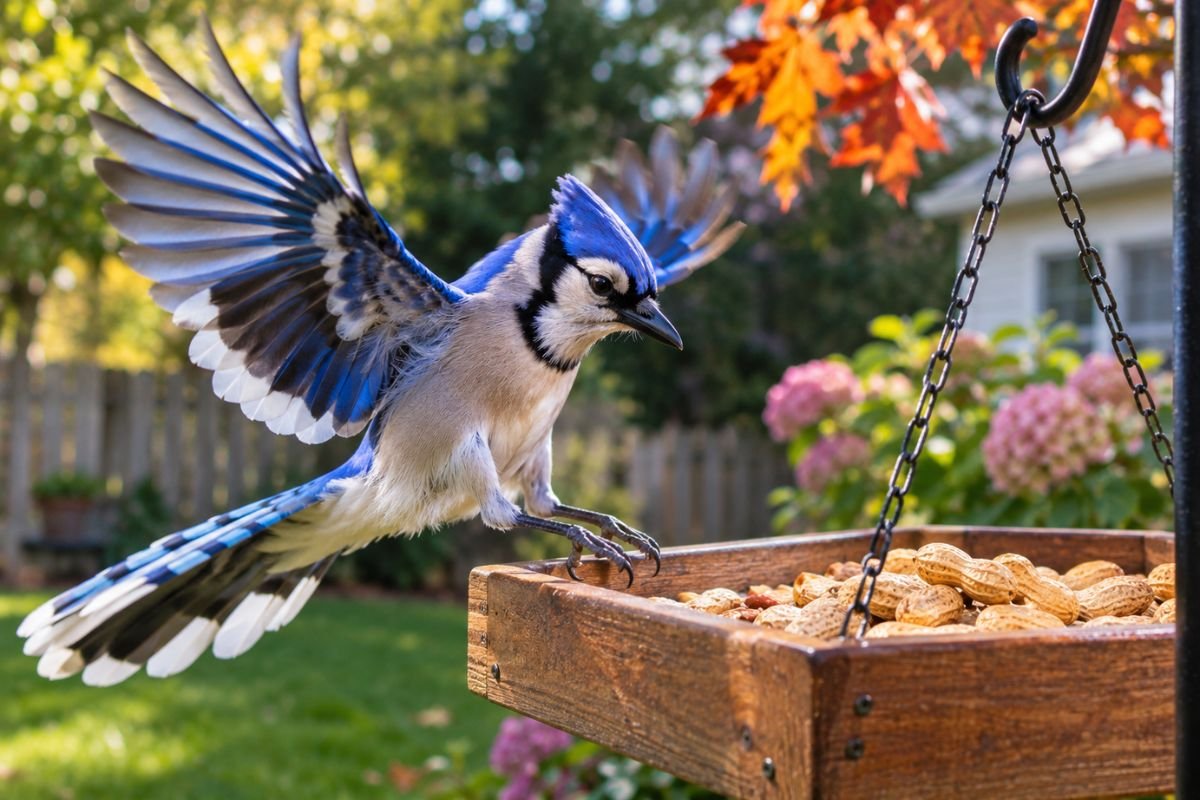
Project FeederWatch reports that Blue Jays readily take peanuts in the shell, peanut pieces, black oil sunflower seed, suet, and safflower seed. Peanuts in the shell are especially good because Blue Jays can grab one, fly off, and cache it, which is exactly what they want to do. If you put out peanuts in the shell, you will often see jays return for load after load until the supply is gone.
Sunflower seed is worth adding too. Cornell notes that Black Oil Sunflower is taken by a wide range of backyard birds, so offering it alongside peanuts means you are feeding Blue Jays and also attracting chickadees, cardinals, and finches at the same time. For more detail on seeds that work for all your winter birds, see our guide on what to feed birds in winter.
Corn is another food Blue Jays love. Audubon notes they eat a great deal of corn and grain. You can offer whole dried corn or cracked corn on a platform feeder or scattered on the ground. Avoid corn if squirrels are already a problem in your yard, since corn draws them even faster than it draws jays.
Choose the Right Feeder for Blue Jays
Blue Jays are large birds, roughly the same size as an American Robin, and they need room to land and feed comfortably. Small tube feeders with short perches do not work well for them. Project FeederWatch explains that feeders with short perches are designed to attract smaller birds and will keep larger species like jays away.
The best feeder options for Blue Jays are:
- Platform or tray feeders. An open tray gives Blue Jays the flat surface and open space they prefer. FeederWatch notes that trays attract the widest range of feeder birds and suit large species especially well.
- Large hopper feeders. A covered tray with walls keeps seed dry and gives Blue Jays enough room to perch. FeederWatch lists large hoppers as one of the best all-around feeder styles.
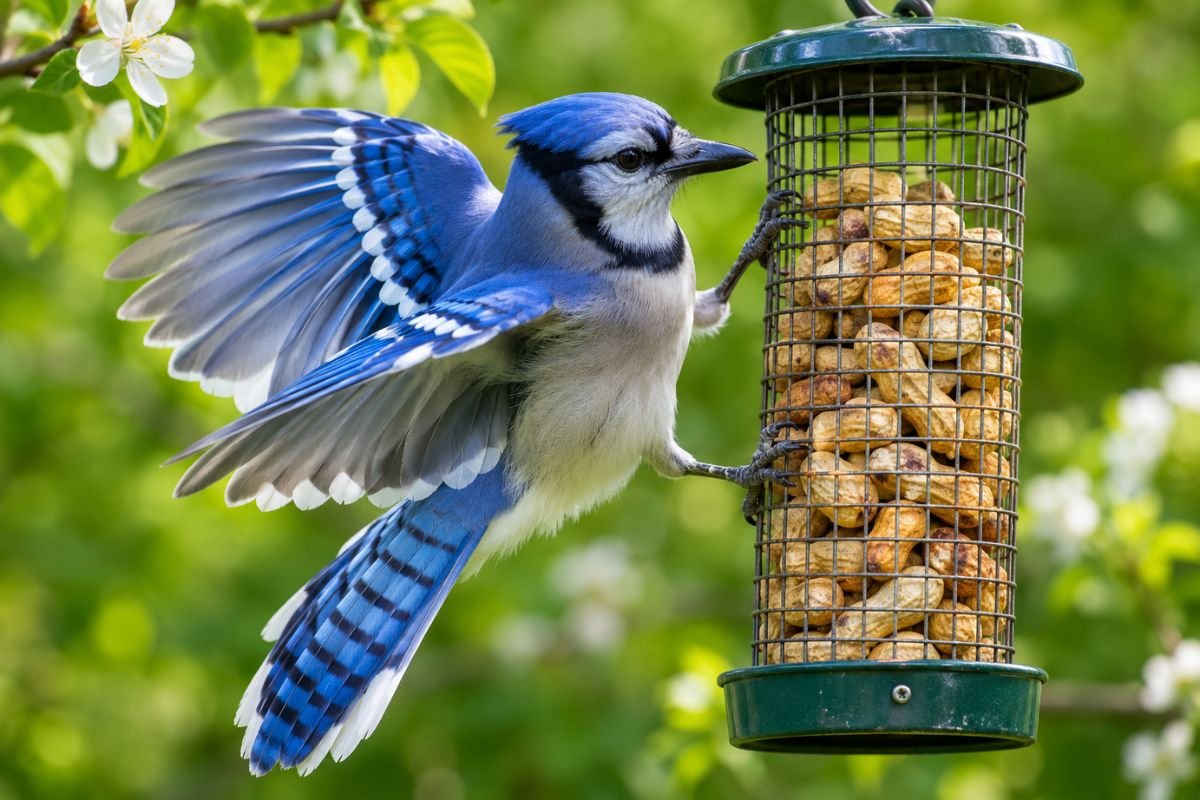
- Peanut feeders. A simple wire mesh cylinder filled with peanuts in the shell. Jays can grip the mesh and pull out whole peanuts, which they carry off and cache one at a time.
Blue Jays will also feed from the ground. If you scatter a handful of whole peanuts or corn on a flat area of your yard, away from brush where predators could hide, jays will spot them quickly. Some birders use this as a way to offer food without an expensive feeder while they are just starting out.
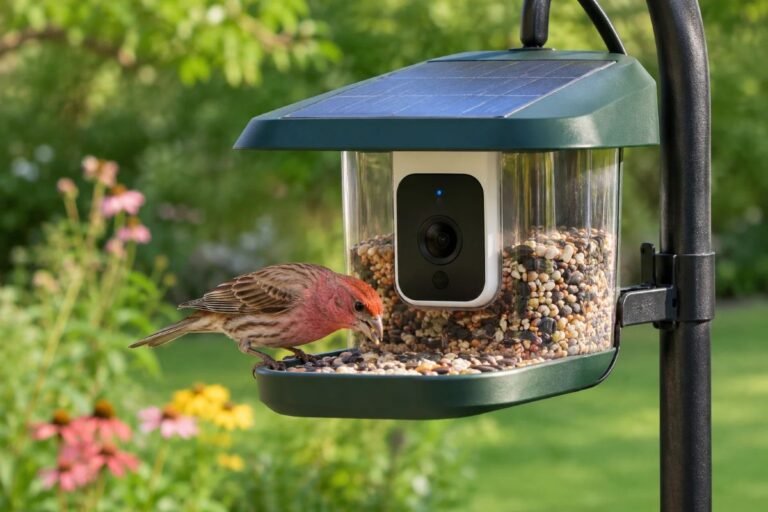
If you want to watch Blue Jays up close without being at the window, a smart camera feeder makes it easy. You can check who visited and replay the clips from your phone. The Birdfy smart camera feeders are a popular choice for this, and our Smart Feeders section covers how camera feeders work in more detail.
Where to Place Your Feeder
Blue Jays prefer to approach a feeder from a tree or large shrub nearby. They will perch up high, scan the area, then drop down to feed, often taking one item and flying back to cache it before returning. Place your feeder within easy gliding distance of a large tree or dense shrub, so jays have a natural flight path to it.
The National Audubon Society recommends the same window rule that applies to all feeders: place them either within 3 feet of a window or more than 30 feet away. Blue Jays are fast fliers and a window collision can injure them. A feeder very close to the glass removes the momentum that makes a window strike dangerous; one far from the house gives birds room to steer clear entirely.
Plant Oak Trees and Berry Shrubs
If you want Blue Jays to treat your yard as a permanent home rather than just a feeding stop, plant the trees and shrubs they depend on year round. The Cornell Lab says the Blue Jay’s favorite natural food is acorns, and it lists oaks as the most important tree for attracting them. Even a young oak in a yard or large container gives jays a reason to stay close.
Beyond oaks, Cornell notes that Blue Jays eat beechnuts, hickory nuts, and the berries and fruits of many shrubs. Audubon lists wild cherry, dogwood, and elderberry among the plants that provide natural food for jays. These plants also shelter insects and serve as perches, making your yard richer for every bird, not just jays.
If your yard is too small for a full-size oak, a large potted tree like a dwarf oak or a native berry shrub can still help. The key is giving jays somewhere to land and something natural to explore when the feeder is empty. For more ideas on plants that support backyard birds, see our guide on how to attract Northern Cardinals, which covers many of the same shrubs.
Add a Birdbath or Water Source
Like most birds, Blue Jays need fresh water for drinking and bathing. The National Audubon Society recommends a birdbath with a shallow basin and a rough bottom surface so birds can grip it without slipping. Blue Jays are larger than most backyard birds, so a bath that is at least 2 to 3 inches deep in the center will work for them.
Moving water is especially effective. Audubon notes that the sound of dripping or trickling water draws birds from farther away than a still bath. A simple dripper or solar-powered pump that you drop into an existing birdbath can make a big difference, particularly in hot, dry summer months when natural water sources are scarce.
In winter, keep the bath ice-free with a plug-in or solar bird bath heater. Cornell advises that birds need water even in cold weather for drinking, since they cannot always find open natural sources in freezing temperatures. A consistently open water source in winter can attract Blue Jays even if you have not set up a feeder yet.
Understand Blue Jay Behavior at the Feeder
Blue Jays have a reputation for dominating feeders and chasing smaller birds away. This is partly true and partly misunderstood. Cornell notes that Blue Jays are aggressive and assertive around food, but they also serve as alarm callers that warn other birds when a predator is nearby. Many birders find that the jay’s loud call sends every bird into the bushes when a hawk appears overhead, which can actually save lives at a busy feeder.
If you want to reduce competition between Blue Jays and smaller birds, the simplest fix is to set up two feeding stations in different parts of the yard. Offer peanuts and corn at one station for the jays, and black oil sunflower in a tube feeder or small hopper at a second station. Project FeederWatch notes that tube feeders with short perches are naturally less attractive to large birds, so this setup tends to work well without needing to exclude either group.
Are Blue Jays Good for the Yard
Some people hesitate to attract Blue Jays because they have heard the birds raid other species’ nests. Cornell confirms that Blue Jays do eat eggs and nestlings on occasion, but notes that this behavior has been observed far less often in studies than the jay’s reputation suggests. Cornell also points out that the data show most Blue Jay diet is plant material, insects, and carrion, with nest raiding being a minor part of their feeding behavior.
The benefits Blue Jays bring to a yard and ecosystem are real. Their role in spreading oak trees is well documented by researchers at Cornell. Their alarm calls warn every bird in the area of approaching danger. And their intelligence and bold personality make them one of the most engaging birds to watch through a window. For most backyard birders, the tradeoffs are worth it.
Quick Checklist to Attract Blue Jays
- Set up a platform feeder or large hopper with peanuts in the shell.
- Add black oil sunflower seed and dried or cracked corn.
- Place the feeder near a large tree or dense shrubs, within 3 feet or beyond 30 feet of windows.
- Keep a birdbath filled with clean, fresh water, and consider adding a dripper.
- Plant oak trees or native berry shrubs if your yard has space.
- Set up a second feeder station to reduce competition with smaller birds.
- Keep food fresh and clean feeders and the water bath regularly.
Blue Jays are rewarding birds to attract. They are bold, intelligent, and visually striking, and they interact with the yard in ways that most quieter birds do not. Get the peanuts out, set up a platform feeder near a tree, and you are very likely to have your first jay visitor within a week.
Sources
- All About Birds: Blue Jay Life History (allaboutbirds.org)
- National Audubon Society: Blue Jay (audubon.org)
- Project FeederWatch: Food Types (feederwatch.org)
- Project FeederWatch: Feeder Types (feederwatch.org)